The Hate Review
Hungary
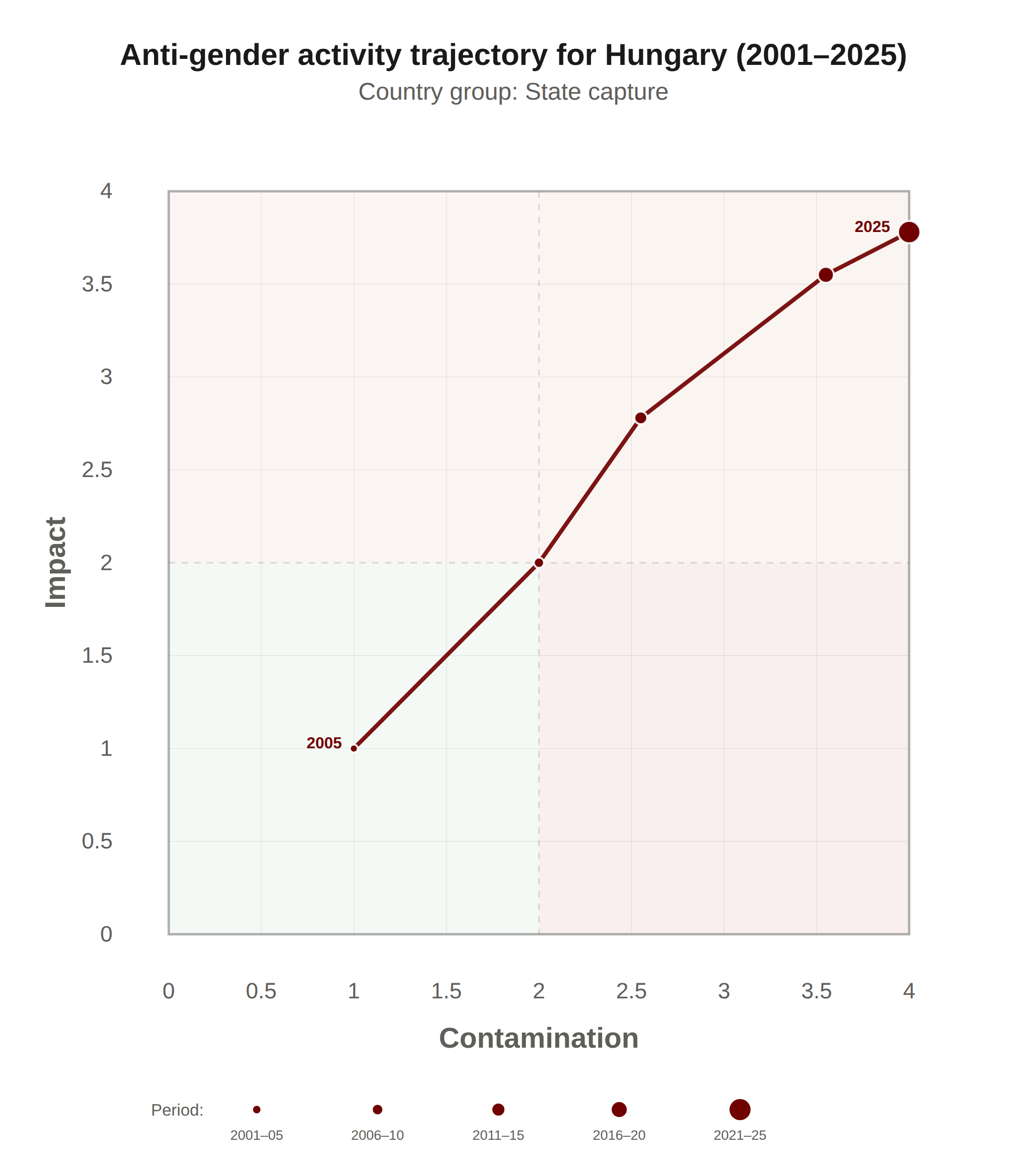
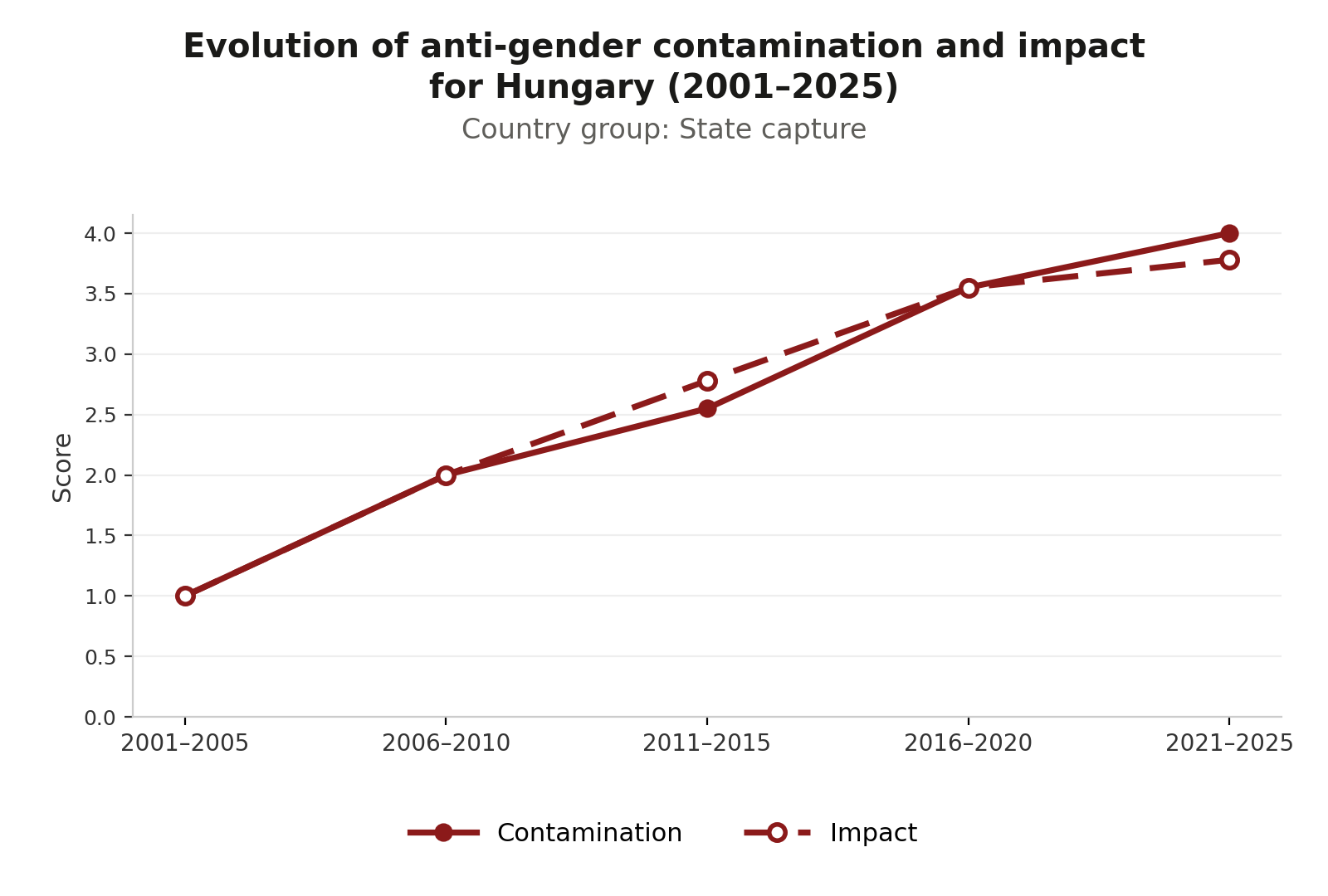
Key indicators in 2025: Contamination 4.00 / 4 · Impact 3.78 / 4
The trajectory of anti-gender activity in Hungary is unlike that of any other EU member state: the government itself has been the primary anti-gender actor, progressively transforming a legal framework that was broadly favourable to equality in 2000 into one of the most restrictive in Europe by 2025. In the 2000s, mobilisation was led by the Catholic Church, the Reformed Church and Jobbik, centred on opposition to same-sex partnership recognition and Budapest Pride. After Fidesz won a supermajority in 2010, this energy was absorbed by the state: constitutional redefinitions, legislative restrictions and executive harassment replaced street protest as primary instruments. From 2015, Orbán fused anti-LGBTIQ+ politics, demographic nationalism and opposition to feminist gains into a single project, with the 2021 “anti-LGBT propaganda” law and the 2025 Pride ban marking the apex. This agenda was also exported through CPAC Hungary and the Budapest Demographic Summit, positioning Hungary as a global hub for the anti-gender movement.
The April 2026 parliamentary elections ended sixteen years of Fidesz rule, bringing Péter Magyar’s Tisza Party to power with a two-thirds majority; what that change will mean for the legal and institutional framework built over the period has yet to materialise.
| Year | Abortion & Reproductive Rights | Sex & Relationship Education | LGBTIQ+ Visibility | Partnerships, Marriage & Family | Legal Gender Recognition & Healthcare | Istanbul Convention | Language & Gender Studies | Civil Society & Democratic Space |
|---|---|---|---|---|---|---|---|---|
| 1990s | ||||||||
| 2000 | ||||||||
| 2001 | ||||||||
| 2002 | ||||||||
| 2003 | ||||||||
| 2004 |
A |
|||||||
| 2005 | ||||||||
| 2006 | ||||||||
| 2007 |
M |
A |
||||||
| 2008 |
PM |
L |
||||||
| 2009 |
OL |
|||||||
| 2010 |
M |
|||||||
| 2011 |
PA |
PM |
P |
|||||
| 2012 |
P |
P |
||||||
| 2013 |
A |
P |
||||||
| 2014 |
M |
|||||||
| 2015 | ||||||||
| 2016 |
P |
P |
||||||
| 2017 |
A |
P |
||||||
| 2018 |
D |
P |
P |
|||||
| 2019 |
M |
|||||||
| 2020 |
PMIT |
P |
P |
P |
||||
| 2021 |
P |
PD |
P |
|||||
| 2022 |
P |
A |
||||||
| 2023 |
D |
P |
||||||
| 2024 |
M |
|||||||
| 2025 |
M |
PLMD |
P |
P |
||||
| 2026 |
L |
| OOpposition to progressive law or regulation/policy | PProposal or implementation of anti-gender law or regulation/policy | LStrategic litigation |
| MProtest or demonstration | IPetition or citizen initiative | AAdvocacy campaign |
| DDisinformation campaign | TTransnational interference |
The evolution of the anti-gender movement in Hungary