The Hate Review
Italy
Country Group: Advanced entrenchment
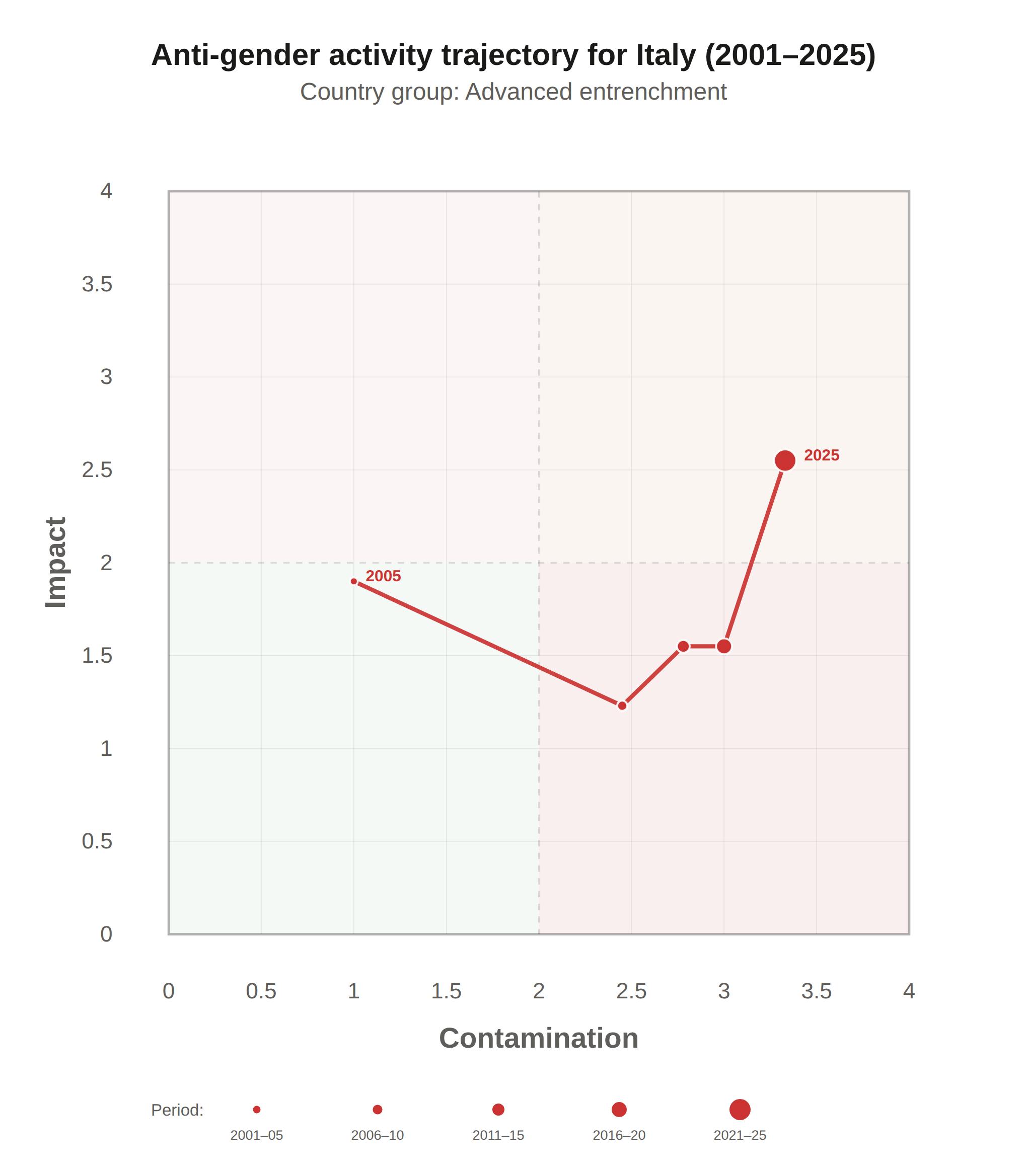
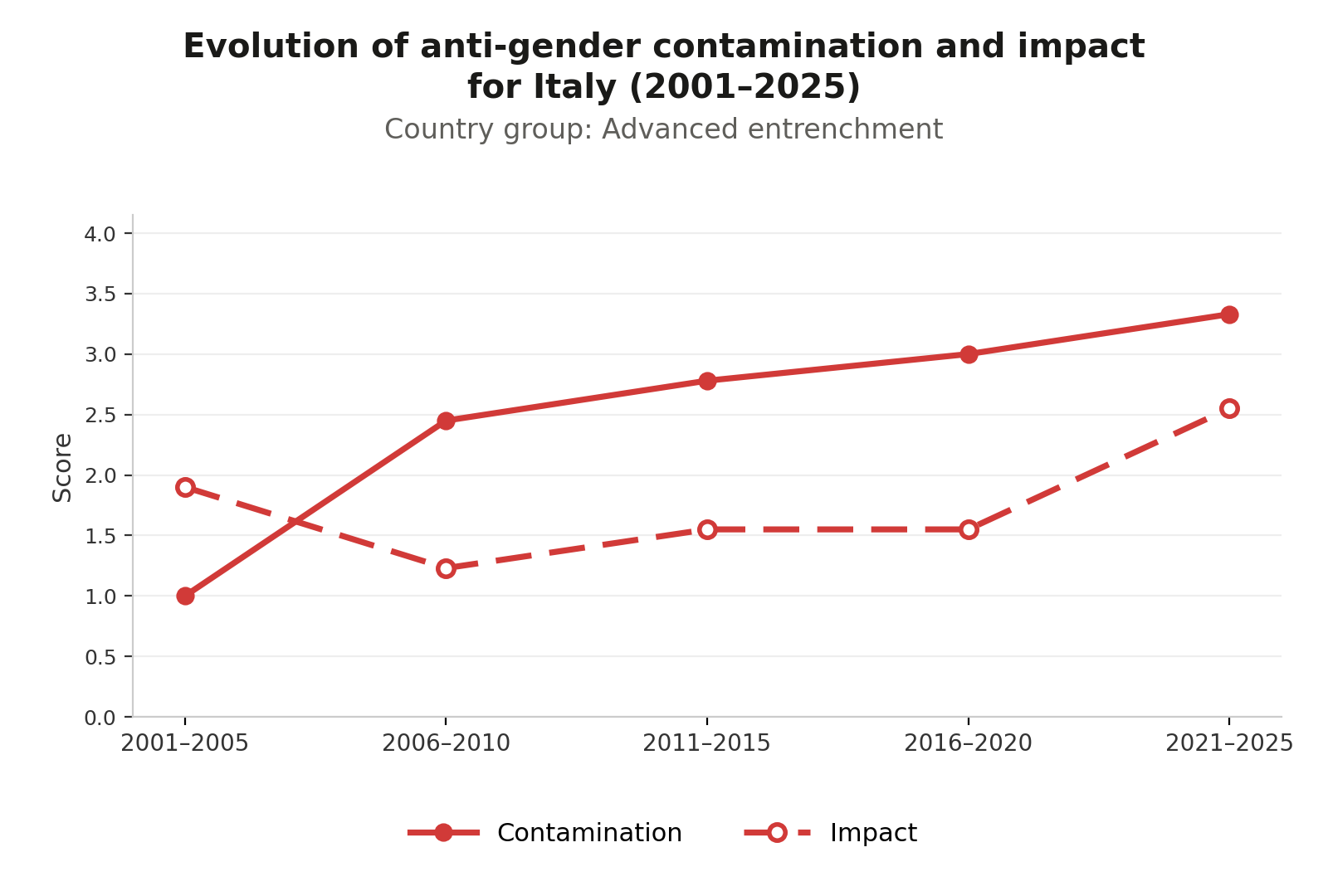
Key indicators in 2025: Contamination 3.33 / 4 · Impact 2.55 / 4
The trajectory of anti-gender activity in Italy over the past decades has been one of gradual institutionalisation: from Church-led moral condemnation and legislative obstruction in the early 2000s, through the emergence of a professionalised civil society ecosystem from 2013, to direct governmental action since 2022. The recurring Family Day rallies gave the movement an unmatched capacity to occupy public space, twice contributing directly to the shelving or dilution of legislation on same-sex couples. Since the election of the Meloni government, the anti-gender agenda has moved decisively from civil society pressure to institutional power — with the executive, ministerial circulars and the parliamentary majority acting as direct instruments of anti-gender policy, marking Italy as one of the countries where the movement has most successfully translated mobilisation into governance.
| Year | Abortion & Reproductive Rights |
Sex & Relationship Education |
LGBTIQ+ Visibility |
Partnerships, Marriage & Family |
Legal Gender Recognition & Healthcare |
Istanbul Convention |
Language & Gender Studies |
Civil Society & Democratic Space |
|---|---|---|---|---|---|---|---|---|
| 1990s | O | |||||||
| 2000 | ||||||||
| 2001 | ||||||||
| 2002 | O | |||||||
| 2003 | ||||||||
| 2004 | P | |||||||
| 2005 | A | L | ||||||
| 2006 | O | |||||||
| 2007 | OM | |||||||
| 2008 | ||||||||
| 2009 | O | |||||||
| 2010 | ||||||||
| 2011 | M | O | ||||||
| 2012 | M | |||||||
| 2013 | M | OMT | ||||||
| 2014 | M | OA | M | IT | ||||
| 2015 | M | I | PA | M | ||||
| 2016 | M | OM | ||||||
| 2017 | M | MT | ||||||
| 2018 | MAT | |||||||
| 2019 | M | |||||||
| 2020 | PMA | MIAT | ||||||
| 2021 | OPM | OAT | ||||||
| 2022 | PM | P | ||||||
| 2023 | M | A | PID | OPL | ||||
| 2024 | PMAT | P | PI | P | I | |||
| 2025 | M | PI | P | P | ||||
| 2026 | M | A |
| OOpposition to progressive law or regulation/policy | PProposal or implementation of anti-gender law or regulation/policy | LStrategic litigation |
| MProtest or demonstration | IPetition or citizen initiative | AAdvocacy campaign |
| DDisinformation campaign | TTransnational interference |
The evolution of the anti-gender movement in Italy