The Hate Review
Romania
Country Group: Advanced entrenchment
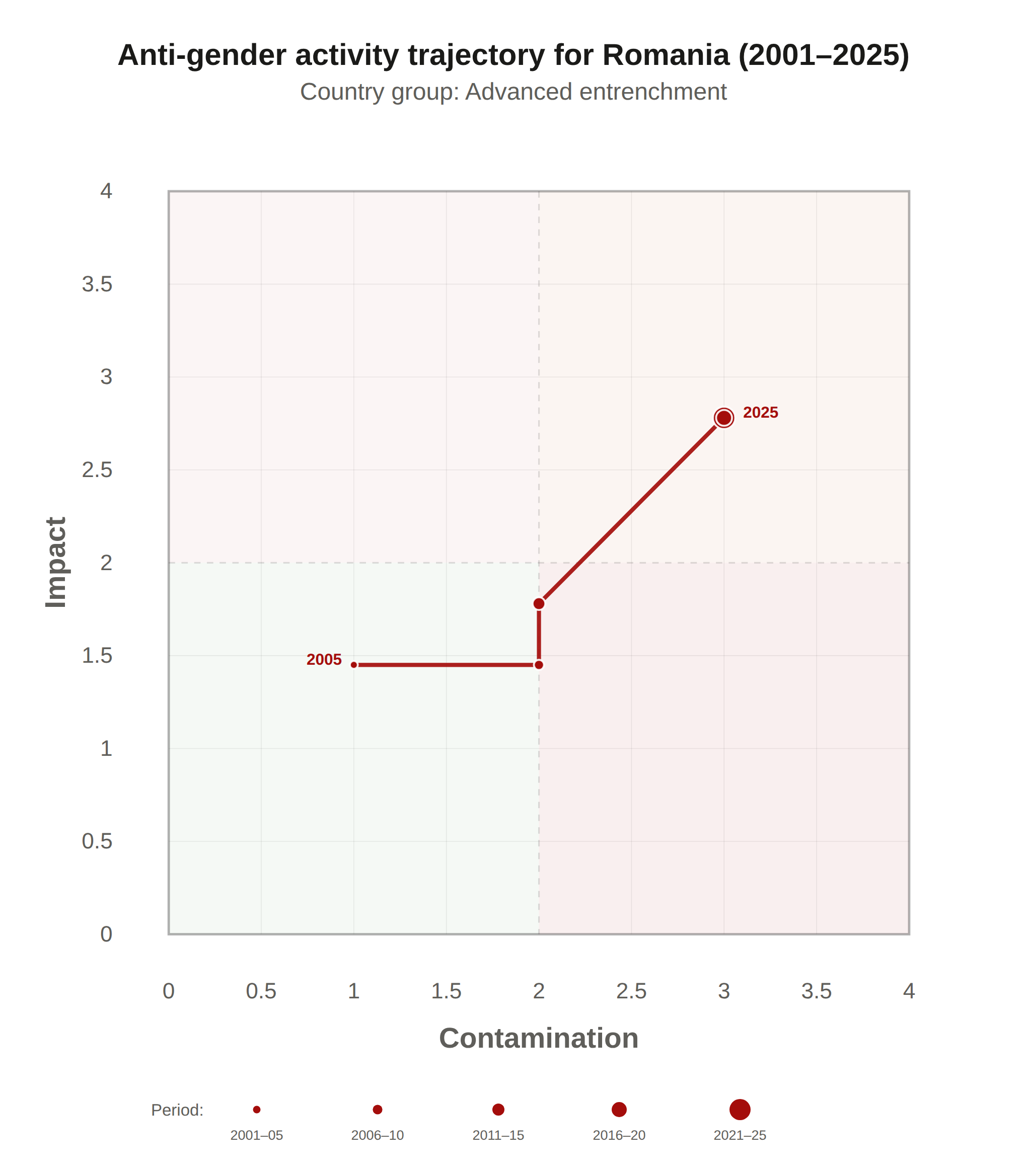
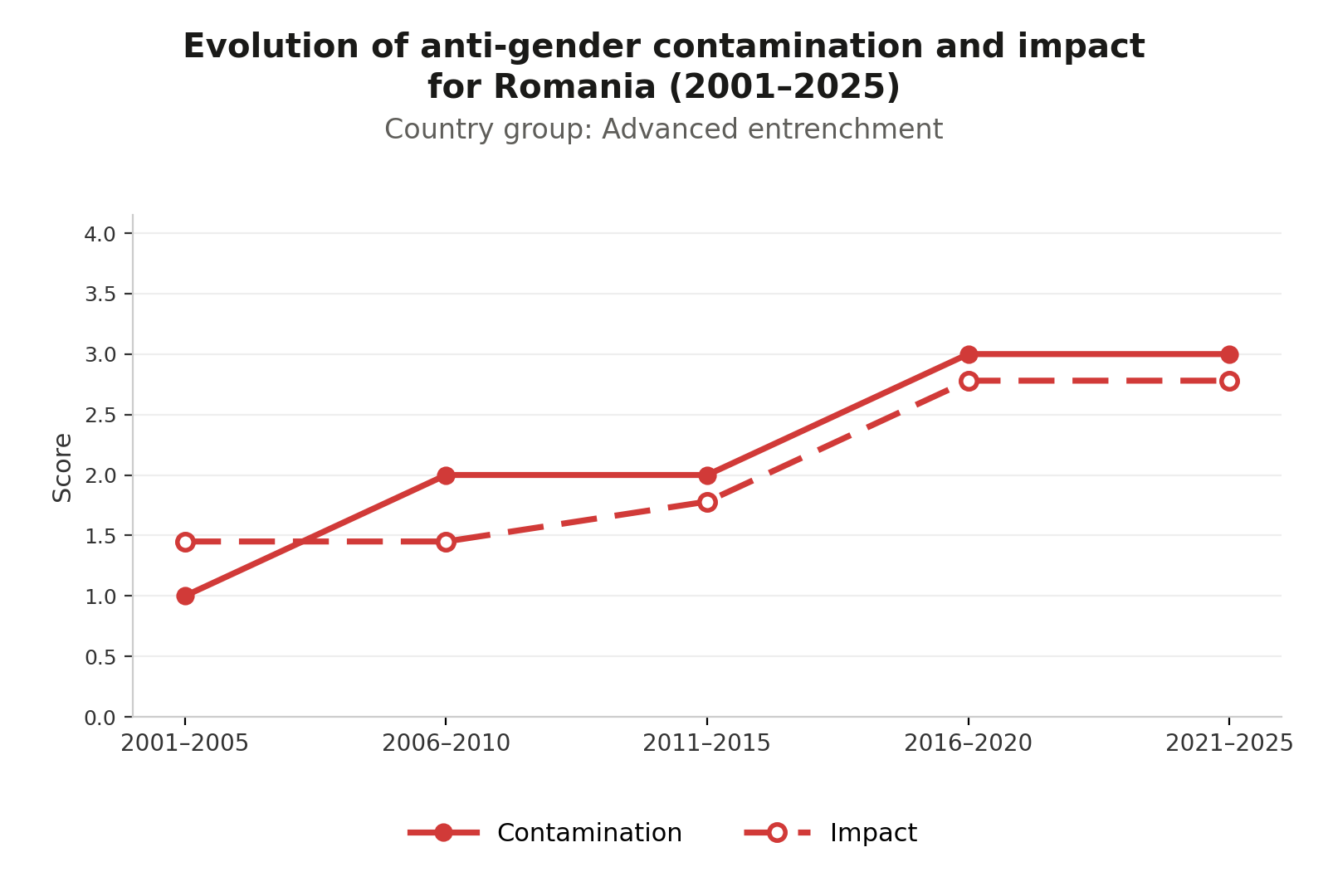
Key indicators in 2025: Contamination 3.00 / 4 · Impact 2.78 / 4
Over the past twenty-five years, anti-gender activity in Romania has followed a trajectory of steady escalation and progressive mainstreaming. Beginning with church-led resistance to decriminalisation in the 1990s, the movement built its first mass infrastructure through the Coalition for Family’s constitutional campaign, culminating in the failed 2018 referendum. The entry of AUR into Parliament in 2020 brought anti-gender narratives into the political mainstream, and the 2024 presidential campaign of Călin Georgescu — whose anti-gender, sovereigntist and conspiratorial messaging reached millions through coordinated social media amplification — marked the movement’s integration into the broadest currents of Romanian populist politics. The trajectory of the country is one of deepening entrenchment, not episodic backlash.
| Year | Abortion & Reproductive Rights |
Sex & Relationship Education |
LGBTIQ+ Visibility |
Partnerships, Marriage & Family |
Legal Gender Recognition & Healthcare |
Istanbul Convention |
Language & Gender Studies |
Civil Society & Democratic Space |
|---|---|---|---|---|---|---|---|---|
| 1990s | A | |||||||
| 2000 | ||||||||
| 2001 | O | |||||||
| 2002 | ||||||||
| 2003 | ||||||||
| 2004 | ||||||||
| 2005 | M | |||||||
| 2006 | MA | |||||||
| 2007 | M | |||||||
| 2008 | M | PM | P | |||||
| 2009 | PM | M | P | |||||
| 2010 | M | M | ||||||
| 2011 | PM | M | ||||||
| 2012 | M | M | ||||||
| 2013 | PM | LMA | ||||||
| 2014 | M | M | O | |||||
| 2015 | M | M | O | |||||
| 2016 | PM | M | LIT | AT | ||||
| 2017 | M | M | AT | |||||
| 2018 | M | O | M | PLADT | AT | |||
| 2019 | M | I | M | O | ||||
| 2020 | M | P | M | A | P | |||
| 2021 | M | PM | ||||||
| 2022 | M | PMT | PT | |||||
| 2023 | M | PM | PLT | |||||
| 2024 | M | PT | PMDT | I | PAT | |||
| 2025 | PM | PM | ||||||
| 2026 | M | M | PA |
| OOpposition to progressive law or regulation/policy | PProposal or implementation of anti-gender law or regulation/policy | LStrategic litigation |
| MProtest or demonstration | IPetition or citizen initiative | AAdvocacy campaign |
| DDisinformation campaign | TTransnational interference |
The evolution of the anti-gender movement in Romania